
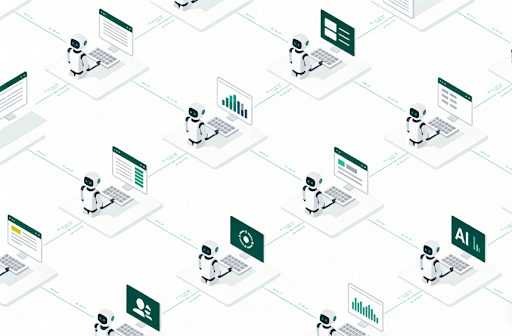
Humans are notoriously terrible at multitasking. Every time you switch your attention from writing a new API endpoint to hunting down a CSS bug, you lose your mental context. It takes an average of twenty minutes to get back into the “zone.” AI coding assistants were supposed to fix this productivity drain, but traditional autocomplete tools only made us type faster. They didn’t change the fundamental constraint of software engineering: you are still working serially. You write a function, you wait. You ask the AI to generate a unit test, you wait.
To truly scale your output and build at the speed of thought, you have to break the single-threaded bottleneck. You must stop acting as a solitary typist and start operating like a load balancer. The next evolution of software engineering isn’t just about autonomous AI; it is about parallel autonomous AI.
The Physics of Code Collisions
The immediate question any experienced developer asks when they hear “multiple AI agents coding at once” is a practical one: How do they not destroy my codebase?
If you have two AI agents attempting to modify the same repository simultaneously, chaos usually ensues. Agent A updates a utility function that Agent B is currently relying on to build a new React component. File conflicts emerge, the language server crashes, and your IDE throws a fit because files are changing on disk faster than it can index them.
The secret to mastering parallel development lies in physical isolation. This is where advanced agentic platforms like Verdent.ai completely change the operational mechanics of coding. Verdent AI solves the concurrency problem by deeply integrating its Parallel Agents with Git worktrees. Instead of forcing multiple AI workers to fight over the same active files in your editor, Verdent spins up isolated, physical sandbox directories for each agent under the hood.
This means Agent A can aggressively refactor your database schema in Worktree 1, and Agent B can upgrade your legacy frontend framework in Worktree 2. Because they are working in isolated environments tied to the same Git repository, your main working branch remains pristine and conflict-free. You can keep writing your core business logic without ever seeing the AI’s messy intermediate steps.
Designing a Multi-Threaded Workflow
Having the ability to run parallel agents is useless if you don’t know how to orchestrate them. You cannot simply throw three agents at a single feature ticket and expect them to figure it out. Parallel development requires a manager’s mindset: you must decouple the work into independent streams.
Here is a blueprint for a highly efficient, three-track parallel workflow you can use today:
Track 1: The Core Architecture (You + Agent) This is your active window. You are tackling the highest-risk, highest-value ticket on your board—perhaps designing a new payment gateway integration. You are actively pair-programming with an agent, iterating rapidly, defining the data structures, and ensuring the business logic is flawless. You are heavily involved here because the cost of failure is high.
Track 2: The Janitor (Background Agent) While you are building the payment gateway, you notice a massive legacy authentication file that is full of deprecated methods. In the old days, you would ignore it (adding to technical debt) because you didn’t have the time. Today, you open a secondary agent panel, point it at the legacy file, and issue a prompt: “Refactor legacy_auth.ts to use our new JWT standard. Ensure all existing interfaces remain intact, and run the test suite in your worktree until it passes.” You send that agent to the background and immediately return to Track 1.
Track 3: The Documenter/Tester (Background Agent) You have an existing API route that was merged last week but has zero test coverage and no documentation. You spin up a third agent: “Generate comprehensive edge-case unit tests for user_routes.go and output a Swagger-compliant YAML documentation file.” In exactly the same amount of time it takes you to finish Track 1, Tracks 2 and 3 are completed by your digital team. You have effectively tripled your output without increasing your cognitive load.
Rules of Engagement: Preventing Agent Chaos
To successfully manage a swarm of parallel workers, you have to enforce strict engineering discipline. If you mismanage them, you will simply generate technical debt at lightning speed.
- Enforce Strict API Contracts First If Agent A is building the backend and Agent B is building the frontend, they will fail if they don’t agree on the data payload. Before dispatching parallel agents on connected tasks, you must define a strict contract. Write a JSON or TypeScript interface file defining the exact inputs and outputs. Give this contract to both agents and instruct them: “Do not deviate from this schema under any circumstances.” This acts as the boundary line that allows them to work independently without breaking the final integration.
- Isolate State-Mutating Tasks Be incredibly cautious when assigning tasks that mutate global state or database schemas. If Agent A is writing a database migration to rename a column, do not have Agent B writing queries against that same table in parallel. Parallel development works best when the agents are working on orthogonal features—like the UI layout, utility functions, or isolated microservices.
- Master the Art of High-Speed Review When your parallel agents finish their tasks, they will submit their isolated worktrees back to you for approval. Your job shifts to Quality Assurance. You must rely heavily on visual diff tools to scan the logic. Do not blindly accept a massive refactor just because the agent says the tests passed. Look for subtle hallucinations: Did it use a deprecated library? Did it remove a necessary error boundary? You are the final gatekeeper for production quality.
Stepping Into the Orchestrator Role
The transition to parallel AI development is jarring at first. We are conditioned to measure our productivity by the continuous clacking of our keyboards. When you dispatch three agents to do the heavy lifting, there will be moments where you are simply sitting back, watching progress bars, and waiting to review code.
Do not mistake this quiet time for unproductivity. This is what architectural leadership looks like.
By mastering parallel agents and worktree isolation, you free yourself from the tyranny of the single-threaded workflow. You stop being a bottleneck and start becoming an orchestrator. The code will be written faster than ever before; your real value now lies in deciding exactly what code needs to be written next.